Corporate jet types for 2026
Corporate jet types group into five classes, from turboprop to heavy jet. A light jet like the Citation CJ4 cruises at 451 knots and carries seven passengers. This page compares cabin, range and cost so a flight department can choose.
- Main
- Planes
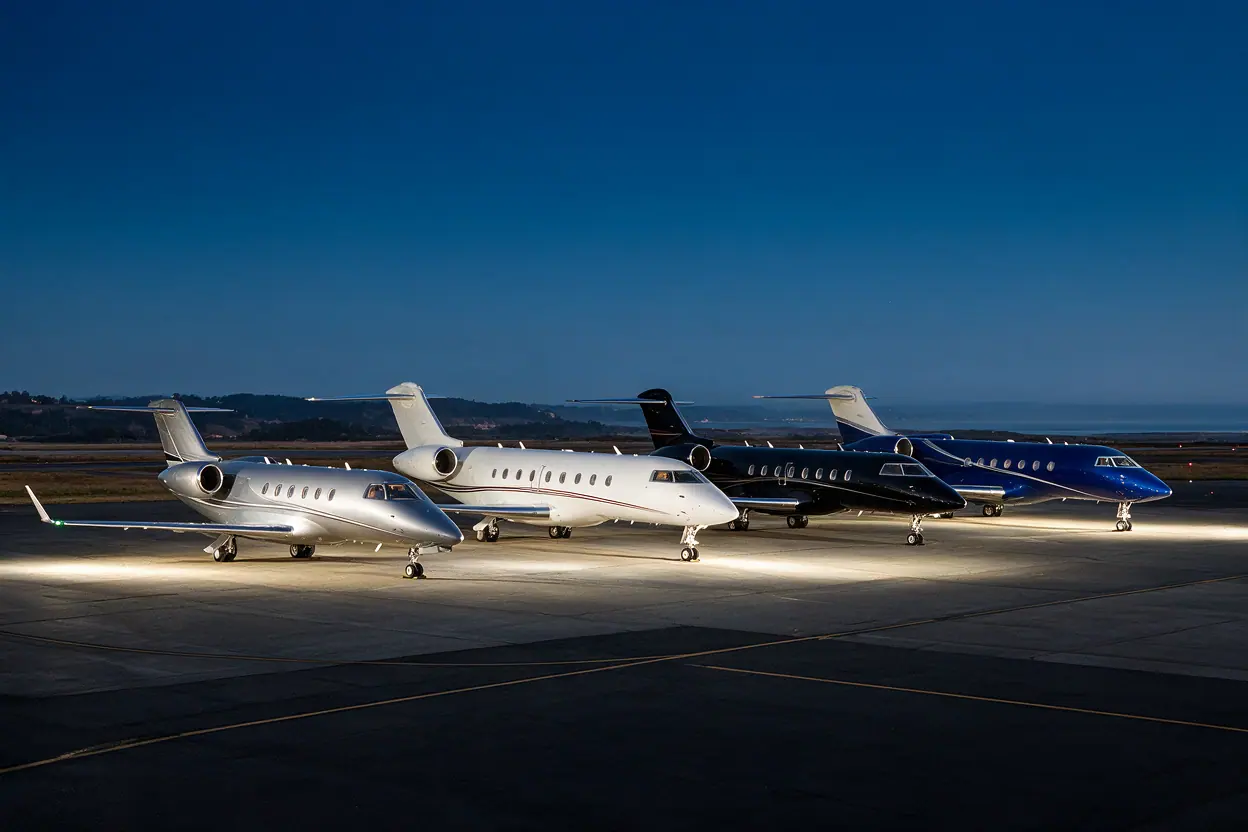
A corporate flight department picks an aircraft by mission, not by brand. The shortest Dallas-Houston hop is 208 nm, so a light jet covers it in 48 minutes. A coast-to-coast New York-Los Angeles run is 2,129 nm and needs a super-midsize or heavy cabin. The table below, drawn from FAA data dated Mar 25, 2026, lists the business aircraft types most often found on Part 135 certificates; it shows which models are common enough to be available on short notice.
Prices on this page are estimates until an operator confirms them, and they move with fuel, crew duty and airport fees. Only a firm quote from a charter broker or operator locks a number. Use the ranges here to screen categories, then ask for a quote on your specific route and date.
Every aircraft type listed cruises between 300 and 482 knots. Cabin altitude and baggage volume matter as much as speed for a working team. The notes below explain what each class does well and where it runs into limits.
Turboprop
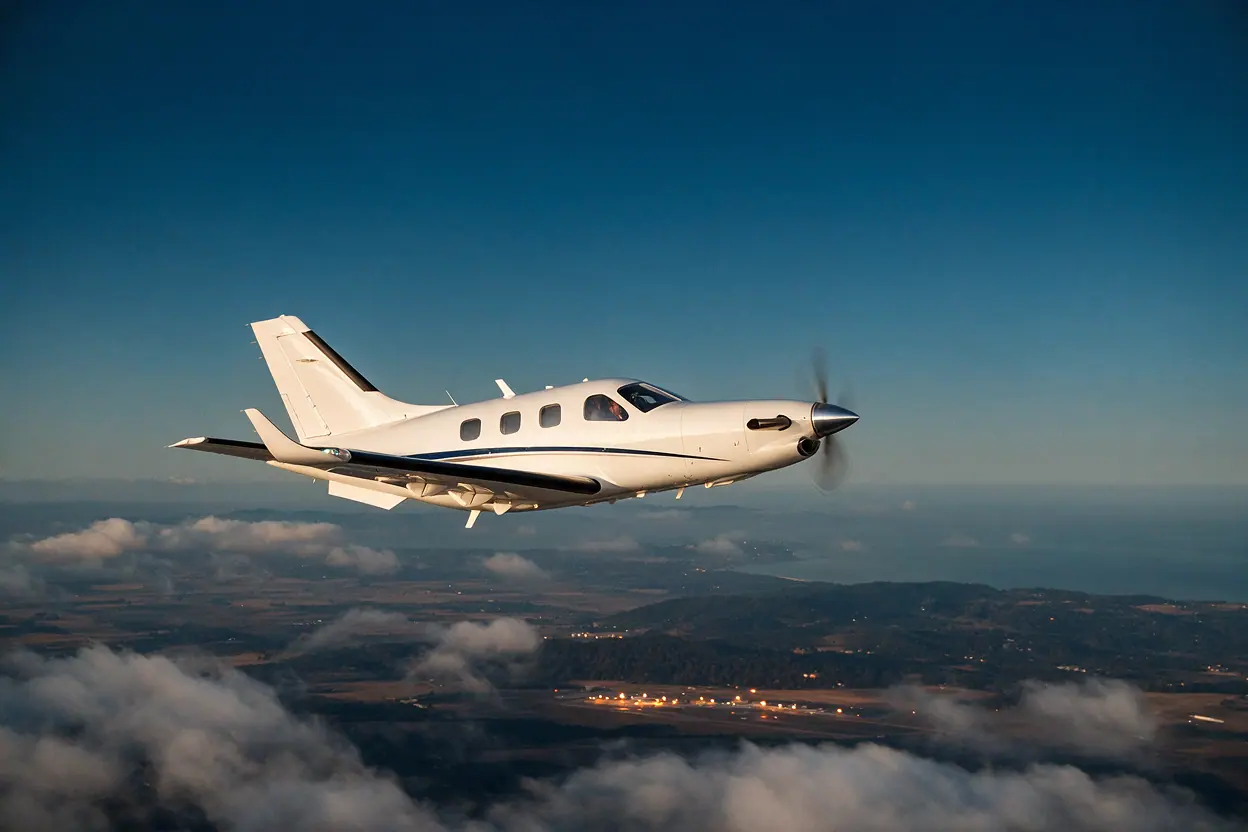
Turboprops are the slowest class at about 300 knots, with a typical range of 1,500 nm and 6-8 seats. Hourly estimates run $2,200 to $3,500. They use shorter runways than jets, which helps at smaller airports. Only use a turboprop when the route is short or the runway is limiting; otherwise a light jet saves time.
Daher TBM 960
- 6 pax
- 330 kt speed
- 1,730 nm legs
The Daher TBM 960 is a single-engine turboprop carrying six passengers at 330 knots with a range of 1,730 nm. Its cabin is 4 ft tall and 13 ft 3 in long, with 32 cu ft of baggage. It suits short trips where a runway is short or a jet is unnecessary.
Beechcraft King Air 350i
- 8 pax
- 312 kt speed
- 1,800 nm legs
The Beechcraft King Air 350i turboprop seats eight at 312 knots and reaches 1,800 nm. The cabin stands 4 ft 9 in tall and runs 16 ft 8 in, with 55 cu ft of baggage. It is a common choice for regional business travel where runway length limits jets.
Light jet
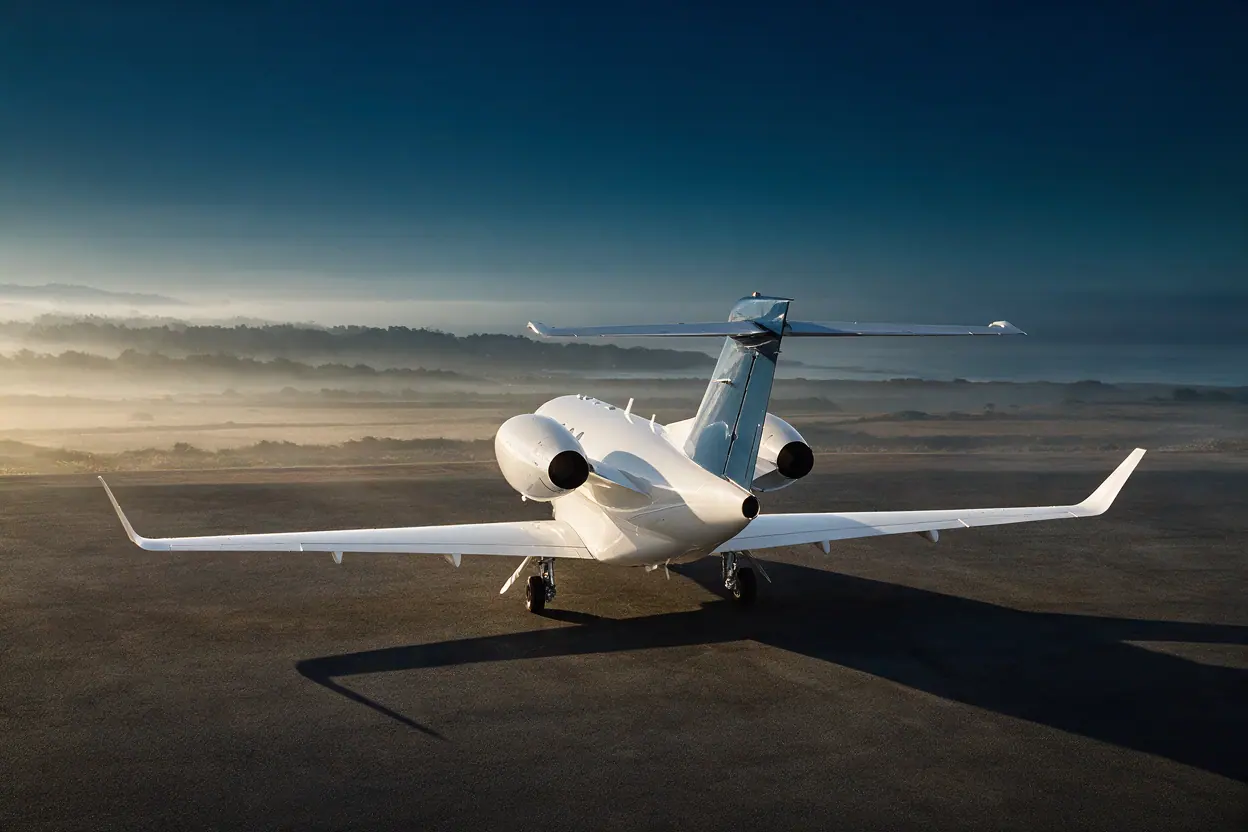
Light jets cruise near 430 knots with 4-7 seats and a typical range of 1,400 nm. Hourly estimates are $3,800 to $5,800. They handle most regional business routes, but a 2,129 nm coast-to-coast leg requires a fuel stop. For two to four passengers on a two-hour flight, the light jet is usually the most efficient choice.
Cessna Citation CJ4 Gen2
- 7 pax
- 451 kt speed
- 2,165 nm legs
The Cessna Citation CJ4 Gen2 light jet carries seven at 451 knots with a range of 2,165 nm. Cabin height is 4 ft 9 in and length 17 ft 4 in; baggage is 71 cu ft. It covers most short and medium business routes nonstop.
Embraer Phenom 300E
- 7 pax
- 464 kt speed
- 2,010 nm legs
The Embraer Phenom 300E light jet seats seven, cruises at 464 knots and has a range of 2,010 nm. Its cabin is 4 ft 11 in tall and 17 ft 2 in long, with 84 cu ft of baggage. It is one of the faster light jets for its class.
Midsize jet
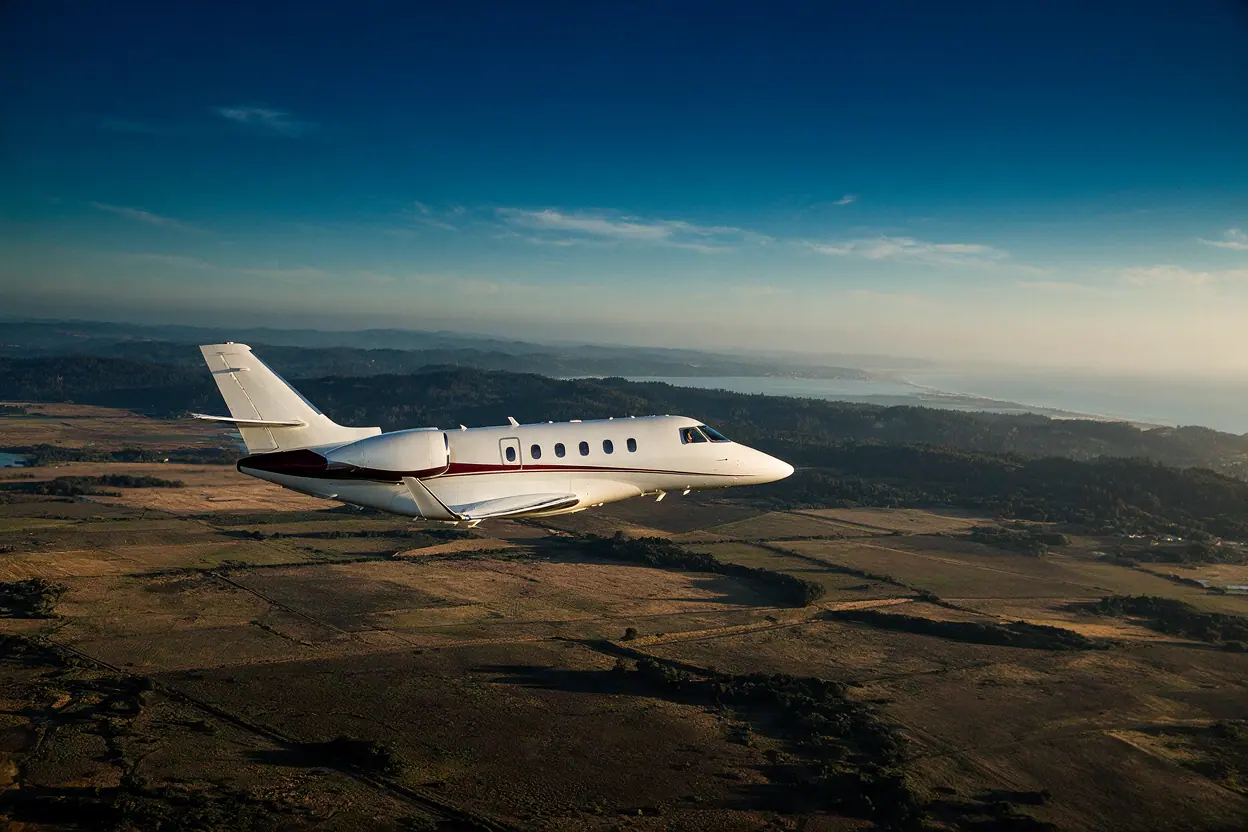
Midsize jets carry 7-9 passengers, cruise around 440 knots and have a typical range of 2,100 nm. Hourly estimates run $5,200 to $7,800. The stand-up cabin makes a three-hour flight productive for a team. A midsize jet can fly New York to Miami nonstop, but not New York to Los Angeles without a stop.
Cessna Citation Latitude
- 9 pax
- 446 kt speed
- 2,700 nm legs
The Cessna Citation Latitude midsize jet carries nine at 446 knots with a range of 2,700 nm. The cabin is 6 ft tall and 21 ft 9 in long, with 127 cu ft of baggage. The stand-up cabin makes it a practical choice for longer regional flights.
Hawker 800XP
- 8 pax
- 447 kt speed
- 2,540 nm legs
The Hawker 800XP midsize jet seats eight at 447 knots and reaches 2,540 nm. Cabin height is 5 ft 9 in and length 21 ft 4 in, with 50 cu ft of baggage. It offers a midsize cabin at a lower hourly cost than newer models.
Super-midsize jet
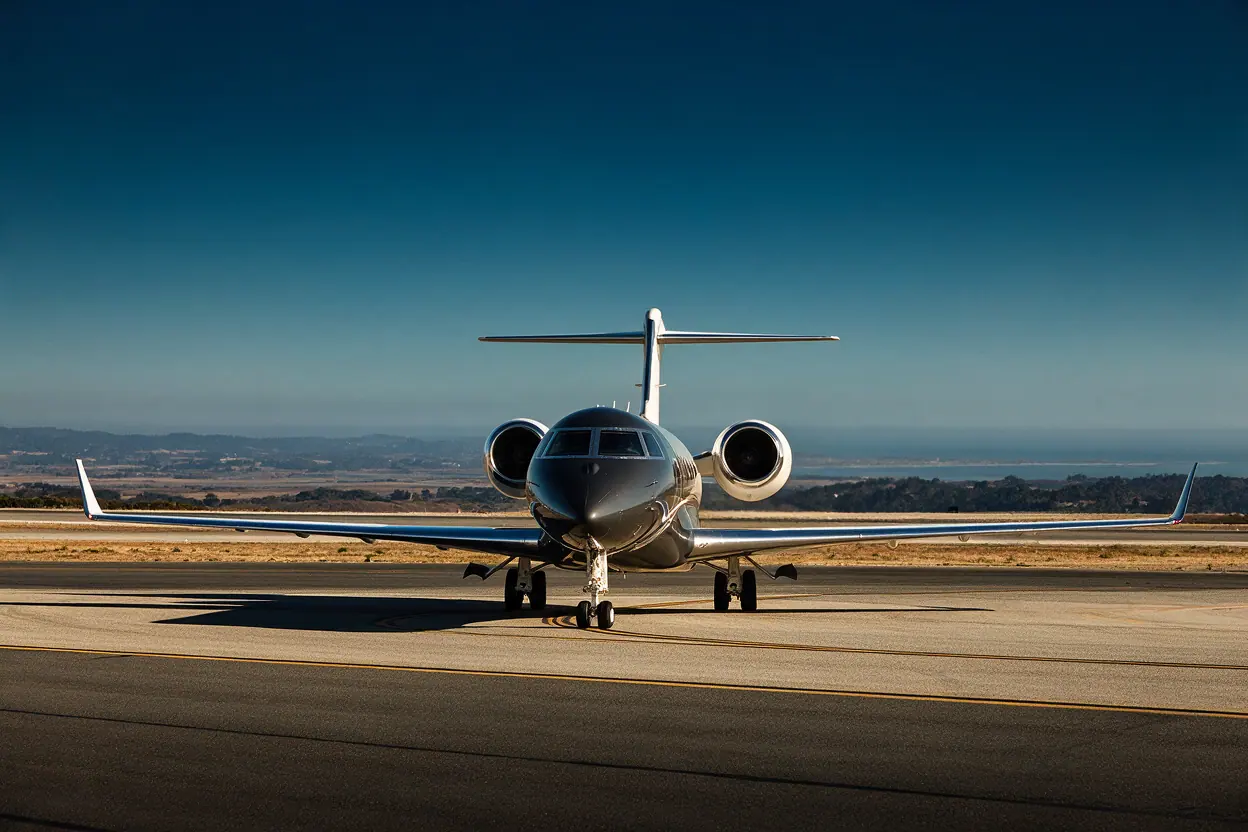
Super-midsize jets seat 8-10, cruise near 470 knots and reach about 3,200 nm. Hourly estimates are $7,200 to $10,000. They cover transcontinental routes nonstop and offer larger cabins and baggage space. For a team of eight flying New York to Los Angeles, this class avoids a fuel stop and keeps the schedule predictable.
Bombardier Challenger 350
- 10 pax
- 470 kt speed
- 3,200 nm legs
The Bombardier Challenger 350 super-midsize jet carries ten at 470 knots with a range of 3,200 nm. Its cabin is 6 ft tall and 25 ft 2 in long, with 106 cu ft of baggage. It can fly transcontinental routes nonstop with a full team.
Gulfstream G280
- 9 pax
- 482 kt speed
- 3,600 nm legs
The Gulfstream G280 super-midsize jet seats nine, cruises at 482 knots and has a range of 3,600 nm. Cabin height is 6 ft 3 in and length 25 ft 10 in; baggage is 154 cu ft. It is the fastest aircraft type listed here.
Heavy jet
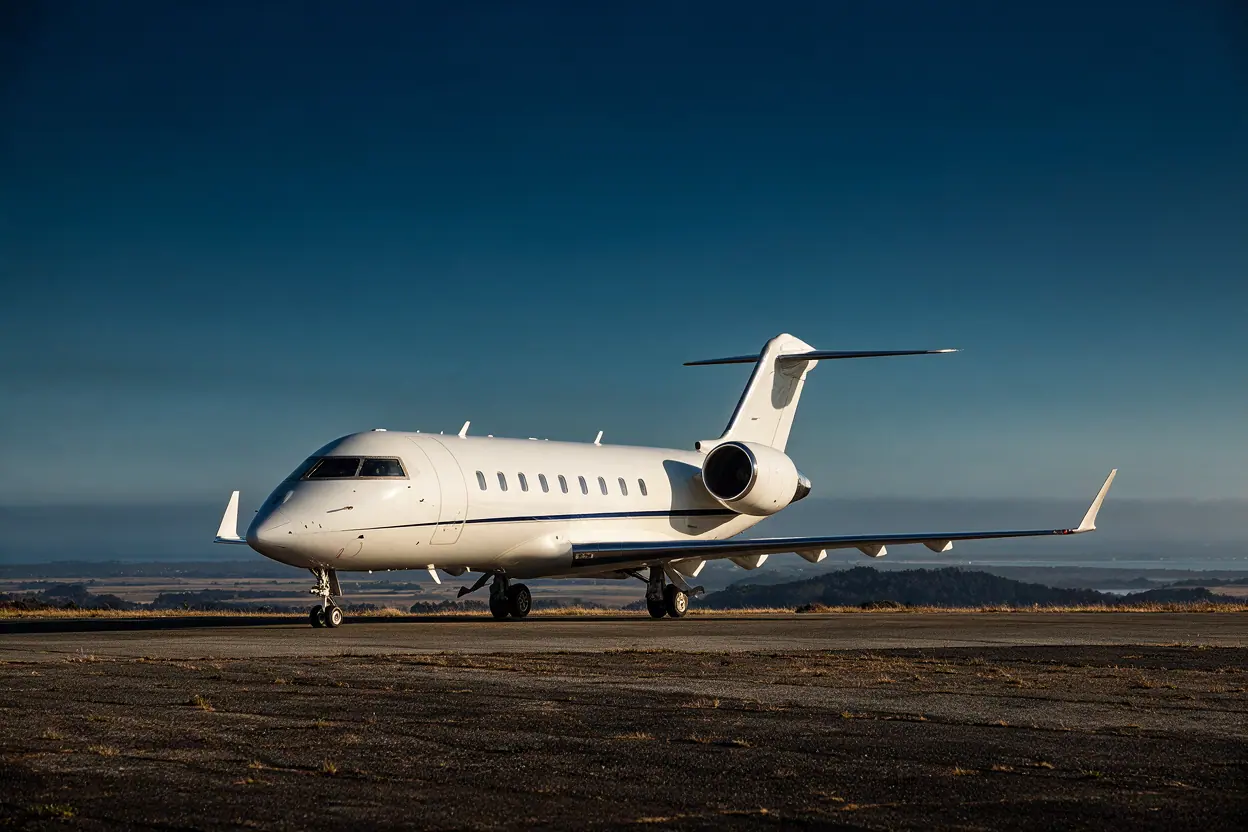
Heavy jets carry 10-14 passengers, cruise about 470 knots and have a typical range of 4,000 nm. Hourly estimates are $9,500 to $14,500. They provide the largest cabins and longest legs, including transatlantic. Use a heavy jet when the passenger count or range demands it; for shorter routes the extra cost buys space, not speed.
Gulfstream G450
- 14 pax
- 476 kt speed
- 4,350 nm legs
The Gulfstream G450 heavy jet carries up to 14 at 476 knots with a range of 4,350 nm. The cabin stands 6 ft 2 in tall and runs 45 ft 1 in, with 169 cu ft of baggage. It suits long transcontinental and transatlantic missions.
Bombardier Challenger 650
- 12 pax
- 470 kt speed
- 4,000 nm legs
The Bombardier Challenger 650 heavy jet seats 12 at 470 knots and reaches 4,000 nm. Cabin height is 6 ft 2 in and length 28 ft 4 in, with 115 cu ft of baggage. It is a common heavy-jet choice for international business travel.
Corporate jet types on certificates
The FAA Part 135 Operators and Aircraft list dated Mar 25, 2026 counts business aircraft by type. The Pilatus PC-12 leads with 450 aircraft, followed by the Bombardier Challenger 300/350 at 414 and the Learjet 35/45/60 at 344. Higher counts mean more aircraft available for charter, which can shorten notice needed for a quote. The table below lists the ten most common types.
| Aircraft type | Class | Listed on Part 135 certificates |
|---|---|---|
| Pilatus PC-12 | turboprop | 450 |
| Bombardier Challenger 300/350 | super-midsize jet | 414 |
| Learjet 35/45/60 | light and midsize jet | 344 |
| Beechcraft King Air 200/350 | turboprop | 333 |
| Embraer Phenom 300 | light jet | 326 |
| Cessna Citation CJ series | light jet | 299 |
| Cessna Citation Excel/XLS | midsize jet | 273 |
| Cessna Citation Latitude | midsize jet | 249 |
| Gulfstream G-V/G550/G650 family | heavy jet | 240 |
| Bombardier Global | heavy jet | 217 |
Source: FAA, Part 135 Operators and Aircraft, list dated Mar 25, 2026. Business aircraft types only.
How to choose among corporate jet types
Match the aircraft to the longest leg first, because range decides whether a flight stops. A light jet has a typical range of 1,400 nm, so a 2,129 nm New York-Los Angeles flight needs a super-midsize or heavy jet or a fuel stop. If the route is 949 nm New York-Miami, then a light jet or midsize jet flies it nonstop. A light jet at 1,400 nm range flies New York to Miami nonstop in about 2 hours 37 minutes, while a coast-to-coast leg needs a larger cabin.
Passenger count and cabin height drive comfort on longer flights. A midsize jet like the Citation Latitude has a 6 ft cabin and seats nine; a light jet cabin is about 5 ft tall. If four people fly a two-hour route, then a light jet keeps costs down. For eight people over four hours, a super-midsize jet provides stand-up cabin space and baggage volume. A super-midsize jet with 3,200 nm range carries eight passengers nonstop from New York to Los Angeles, avoiding a fuel stop that adds time.
Airport performance is the third filter. Hot days and high elevations reduce performance; Centennial Airport near Denver sits at 5,885 ft and reports a peak density altitude of 9,800 ft. If a departure airport is hot and high, then a turboprop or light jet may face payload limits. A turboprop at 300 knots uses shorter runways than a light jet at 430 knots, which matters at smaller fields. Ask the operator to confirm performance for your departure airport and date.
Cost is the last filter, and quoted prices are estimates until an operator confirms. Turboprops run $2,200 to $3,500 per hour; light jets $3,800 to $5,800; midsize $5,200 to $7,800; super-midsize $7,200 to $10,000; heavy $9,500 to $14,500. A light jet at $3,800 to $5,800 per hour handles most regional business routes for four to seven passengers, while a heavy jet costs roughly three times as much per hour. Choose the smallest class that meets range and passenger needs; if the route is short, then the savings are real.
How much of this fleet operates in the US
Per the FAA registry, 18,165 business jets and 13,001 turboprops hold valid US registrations; fractional ownership accounts for 905 of the jets, and the typical jet rolled out in 2008.
| Jet | Grouped under | US-based | Mostly registered in |
|---|---|---|---|
| Daher TBM 960 | TBM 700-960 series | 987 | Delaware (117) |
| Beechcraft King Air 350i | King Air 350 series | 748 | Texas (82) |
| Cessna Citation CJ4 Gen2 | Citation CJ4 series | 410 | Texas (64) |
| Embraer Phenom 300E | Phenom 300 series | 660 | Ohio (81) |
| Cessna Citation Latitude | Citation Latitude | 392 | Utah (12) |
| Hawker 800XP | Hawker 800 series | 353 | Delaware (81) |
| Bombardier Challenger 350 | Challenger 300/350 series | 868 | Utah (120) |
| Gulfstream G280 | Gulfstream G280 | 289 | Utah (47) |
| Gulfstream G450 | Gulfstream IV/G450 series | 610 | California (86) |
| Bombardier Challenger 650 | Challenger 600-650 series | 562 | Utah (63) |
Origin: FAA aircraft registry, valid registrations only, as of Nov 2, 2026. Types are tallied under their type-certificate family.
Business jet registration by state
| State | Registry count |
|---|---|
| Texas | 1,671 |
| Utah | 1,578 |
| Florida | 1,569 |
| Delaware | 1,556 |
| California | 1,044 |
| Ohio | 675 |
| Tennessee | 649 |
| North Carolina | 479 |
| New York | 460 |
| Kansas | 399 |
Good to know
How much is a corporate jet?
Charter estimates run from $2,200 to $3,500 per hour for a turboprop and $3,800 to $5,800 for a light jet. Midsize jets are $5,200 to $7,800, super-midsize $7,200 to $10,000, and heavy jets $9,500 to $14,500. These are estimates until an operator confirms them; a specific route quote depends on distance, crew duty and airport fees.
What is a category 3 aircraft?
In common industry use, category 3 refers to a midsize jet class, carrying roughly 7 to 9 passengers with a typical range near 2,100 nm and cruise speeds around 440 knots. Examples include the Citation Latitude and Hawker 800XP. The term is not a formal FAA category; always confirm the exact aircraft model and its range for your route.
What are the two types of jet engines?
Corporate jets use turbofan engines, while turboprops use turboprop engines driving a propeller. Turbofans power light, midsize, super-midsize and heavy jets at cruise speeds of 430 to 482 knots. Turboprops cruise near 300 to 330 knots and are efficient on shorter routes. The engine type affects speed, runway performance and hourly cost.
Which corporate jet types are most common on Part 135 certificates?
The FAA Part 135 Operators and Aircraft list dated Mar 25, 2026 shows the Pilatus PC-12 turboprop with 450 aircraft, the most of any business type. The Bombardier Challenger 300/350 follows with 414, Learjet 35/45/60 with 344, and the Beechcraft King Air 200/350 with 333. Higher counts generally mean more aircraft available for charter.