Corporate Jet New York to Miami
Corporate jet New York to Miami means one aircraft, one crew, and a schedule set by the people flying. A light jet covers the 949 nautical miles nonstop in about 2 hours 37 minutes, with four to seven passengers. The trip is priced for the cabin, not the headcount.
- 949 nm1,092 sm
- 2h 37mlight jet duration
- $10,000–$15,000one-way quote
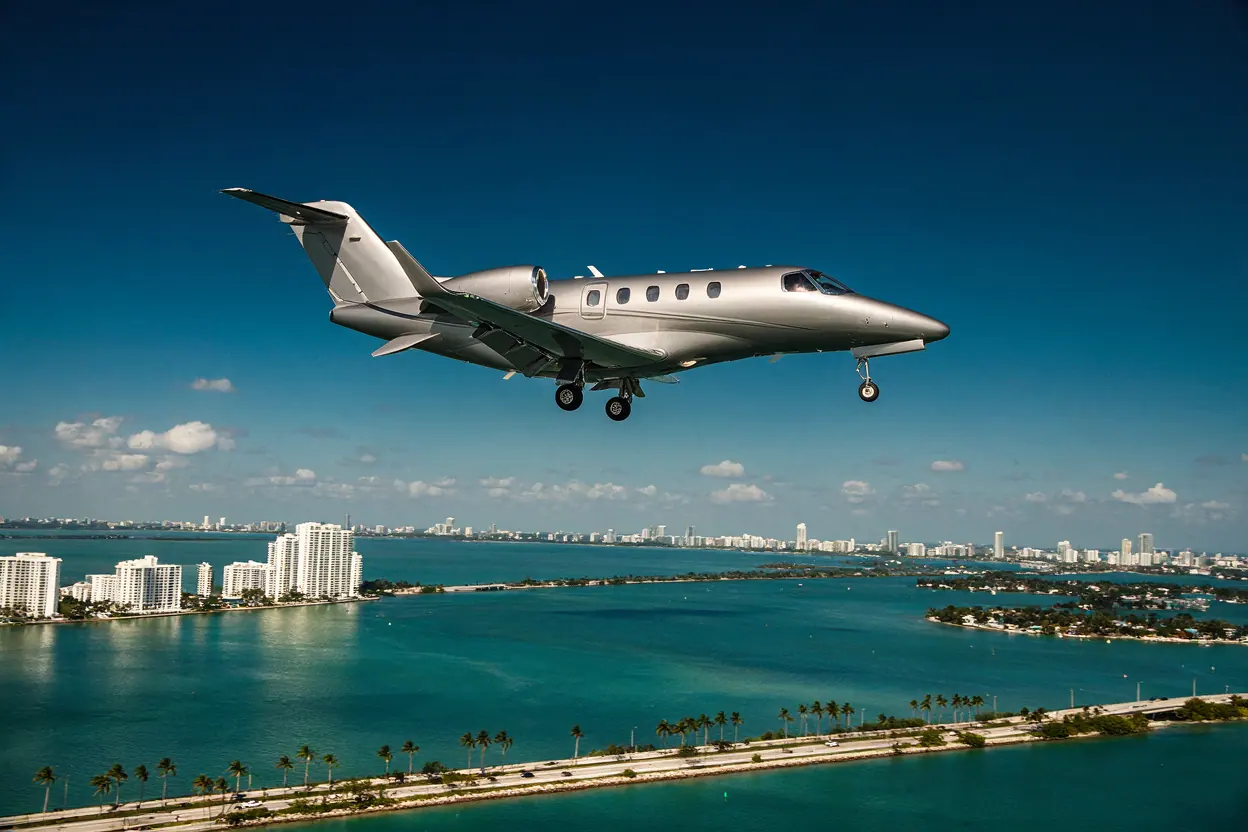
Aircraft pricing for New York to Miami private jet
A private jet from New York to Miami flies 949 nautical miles in 2h 37m on a light jet, quoted at $10,000–$15,000 one way.Times below are block hours, runway to runway, and prices are pre-arranged estimates for the whole aircraft. The light jet numbers reflect the two aircraft named further down; the rest are typical type ranges. Ask for the model, year, and interior photos before you compare quotes.
| Jet category | En route time | Single-leg est. | Detail |
|---|---|---|---|
| Turboprop | 3h 37m | $8,000–$12,500 | Nonstop |
| Light jet | 2h 37m | $10,000–$15,000 | Preferred match |
| Midsize jet | 2h 34m | $13,500–$20,000 | Nonstop |
| Super-midsize jet | 2h 25m | $17,500–$24,000 | Nonstop |
| Heavy jet | 2h 25m | $23,000–$35,000 | Nonstop |
Priced per aircraft, not per passenger, excluding federal excise tax and segment fees. Block time covers taxi, climb, and descent.
Airline ticket costs vs charter, New York–Miami
Airline prices are the lowest fares Google Flights displayed for one passenger on Dec 9, 2026 (checked Nov 15, 2026); the charter row is our estimate for the entire aircraft. For 7 passengers, first class airline seat tickets total about $2,548, compared with $10,000–$15,000 for the whole light jet.
| Way to fly | Operator | Dur. | Single-leg est. | Per seat |
|---|---|---|---|---|
| Coach on the airlines | Delta · nonstop | 3h 13m | $174 | $174 |
| First class airline seat | Delta · nonstop | 3h 16m | $364 | $364 |
| Light jet | Full plane, seating as many as 7 | 2h 37m | $10,000–$15,000 | $1,430–$2,140 |
Airline ticket prices shift daily and cover no bags past the fare allowance; the per-seat charter number assumes every seat is occupied.
How a light jet suits this mission
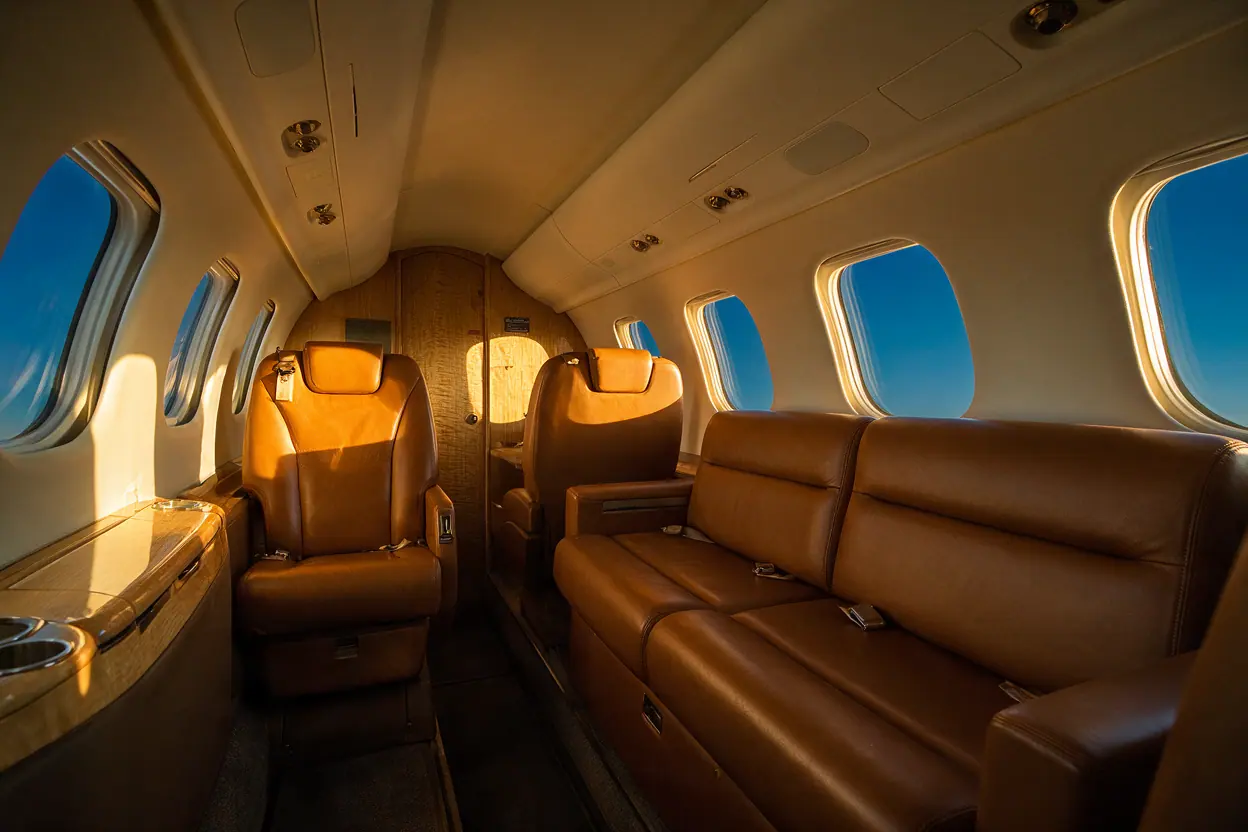
At 949 nautical miles, a light jet is the right choice: a Citation CJ4 or Phenom 300 flies this nonstop from Teterboro and lands in 2h 37m, which keeps the invoice near $10,000-$15,000 for the whole aircraft and beats any midsize quote on short notice. Both models carry up to seven passengers with a 71-84 cu ft baggage hold, enough for a team with briefcases and garment bags.
If your group is larger or your schedule can shift at the last minute, a midsize jet or super-midsize makes sense. A super-midsize jet costs $17,500-$24,000 but only saves 12 minutes over a light jet on this 1,092-mile route, so the upgrade is about cabin comfort and availability rather than speed. A turboprop is slower and rarely cheaper per mile on this distance.
Cessna Citation CJ4 Gen2
- 7 pax
- 451 kt speed
- 2,165 nm legs
Cabin size 4 ft 9 in tall, 17 ft 4 in long. Bags 71 cu ft.
Embraer Phenom 300E
- 7 pax
- 464 kt speed
- 2,010 nm legs
Cabin size 4 ft 11 in tall, 17 ft 2 in long. Bags 84 cu ft.
Best times to book this route
Demand on New York to Miami peaks in winter, from about December through March, when snowbirds and holiday travel push light jet availability down and prices toward the top of the $10,000-$15,000 band; late November and the weeks around the Miami art fairs in December are also tight. Book two weeks out for January and February Friday departures, when light jet aircraft fill first, and ask for a quote hold rather than paying a deposit before the schedule is fixed.
For the return leg, Sunday afternoons in season are the hardest slot to find, so book both directions at once and keep a one-hour buffer. If you can move the trip to Tuesday or Wednesday, availability improves and the same aircraft often comes down a few thousand dollars. A same-day round trip is routine on this distance because the crew can wait at Opa Locka, but confirm the waiting terms and any overnight crew cost before you sign.

Leaving from Teterboro or Westchester
Teterboro (KTEB) is the default New York departure for this route, with 6,997 feet of runway and a short hop from Midtown Manhattan; Westchester County (KHPN) has 6,549 feet and serves the northern suburbs. Teterboro's 6,997-foot runway handles a fully loaded CJ4 in summer heat, though weight limits can apply on very hot afternoons when fuel and bags are full.
If you are flying international onward, CBP clearance needs to be arranged at the departure or arrival airport in advance. Otherwise, you drive to the FBO and board without a terminal walk. A shared limo or a couple of cars from Manhattan beats worrying about parking when the whole group meets at the FBO.
Landing in Miami: Opa Locka or MIA
Miami-Opa Locka Executive (KOPF) is the practical arrival for most charter flights, with an 8,002-foot runway and a quicker exit toward the Beaches and Downtown than MIA. Miami International (KMIA) has 13,016 feet and makes more sense if your destination is Coral Gables or the airport-adjacent business district. Opa Locka is 8,002 feet of runway and steady FBO traffic, which keeps the taxi short after a 2h 37m leg.
When the return leg is the same day, the crew holds the aircraft at Opa Locka and you drive back to the FBO for the evening flight. If you are meeting clients at MIA instead, allow extra time for the larger field's ground movement. Summer heat is worth checking only if your schedule or baggage is tight.
| Field | ID | Rwy |
|---|---|---|
| Miami-Opa Locka Executive Airport | KOPF / OPF | 8,002 ft |
| Miami International Airport | KMIA / MIA | 13,016 ft |
| Teterboro Airport | KTEB / TEB | 6,997 ft |
| Westchester County Airport | KHPN / HPN | 6,549 ft |
Comparable private jet routes for New York – Miami
These 6 private jet routes cover 808 to 1,042 nautical miles, with one-way light jet estimates ranging $8,500 to $16,500.

This route’s FAQs
How fast is a corporate jet New York to Miami?
A light jet flies the 949 nautical miles nonstop in about 2 hours 37 minutes block time, which is the time between leaving the Teterboro ramp and parking at Opa Locka. A super-midsize or heavy jet covers the same 1,092 statute miles in roughly 2 hours 25 minutes, so the faster cabins save only minutes, not hours, on this route.
How much does a corporate jet from New York to Miami cost?
Estimates for a light jet run $10,000-$15,000 for the whole aircraft, based on a Citation CJ4 or Phenom 300 filling four to seven seats. Midsize quotes sit at $13,500-$20,000, and super-midsize at $17,500-$24,000. These are 2026 planning figures, not fixed prices, and they do not include crew overnight or de-icing.
Which airports serve this route from New York?
Teterboro (KTEB) and Westchester County (KHPN) are the standard departures; Teterboro's 6,997-foot runway fits a loaded light jet and sits closer to Midtown. On the Miami end, Opa Locka Executive (KOPF) with 8,002 feet is the usual charter arrival, and Miami International (KMIA) with 13,016 feet is the option if your meeting is near Coral Gables.
Can I do a same-day round trip from New York to Miami by private jet?
Yes. The 2h 37m light jet leg means you can leave Teterboro in the morning, spend the day in Miami, and return the same evening. Book both legs together, ask what the crew's waiting terms are at Opa Locka, and keep the return departure well clear of after-dark thunderstorms in summer.
How many passengers can a light jet carry on this route?
The recommended light jets carry up to seven passengers with a 71-84 cu ft baggage hold, enough for a small team and their bags. On the full 949-nautical-mile leg, the CJ4 and Phenom 300 both do it nonstop, but the last row can be tight for seven with full luggage, so consider a midsize if everyone travels heavy.
When should a company book corporate jet flights New York to Miami?
For winter, from December through March, get the request in two weeks before the intended date, since light jet availability tightens on Friday departures and Sunday returns. Off-peak, a few business days is usually enough. If the trip is flexible by a day or two, the quote often lands nearer the low end of the range.